The Defendant “Snapped”
Defending JacobThe Defendant “Snapped” is the prosecution’s carefully repeated explanation for why Jacob Barber killed Ben Rifkin: a brief provocation, Logiudice argues, triggered a lethal temper and a conscious decision to murder. The phrase turns a difficult, apparently motiveless case into a story the jury can carry into deliberations. Yet the opening statement also describes advance planning and deliberate action, leaving “snapped” suspended between sudden rage and calculated intent.
The opening-statement theme
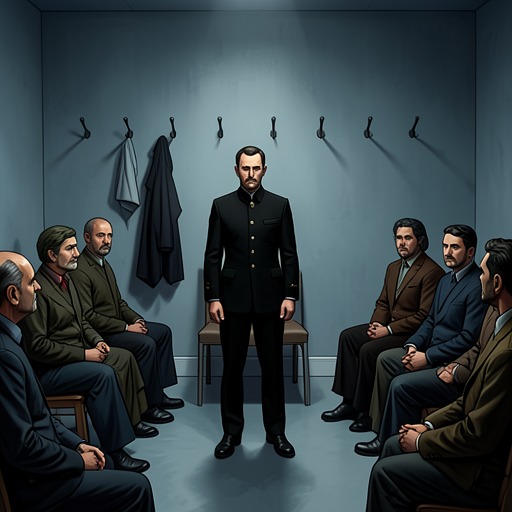
Neal Logiudice introduces the killing through its setting and stakes: a fourteen-year-old found dead in Cold Spring Park, not far from the school he was walking to and the home he had left that morning. He insists that the decision to take a life can form in a second, then snaps his fingers to make that instant visible. In legal terms, he calls the mental decision malice aforethought, arguing that even a swiftly formed intention can satisfy the element. The phrase “The defendant snapped.” condenses that argument into a refrain.
The refrain is part of a larger piece of courtroom storytelling. Logiudice’s instructions to himself, as reconstructed by Andrew Barber, emphasize that facts alone are not enough: jurors need a story of the case, a theme they will repeat when they meet to decide it. “The defendant snapped” supplies just such a theme, joining temper, provocation, and murder in a memorable sequence. The repeated finger-snap makes the phrase a performance as well as a proposition: the prosecutor uses gesture and rhythm to give the proposed cause the appearance of a simple, decisive instant.
The people and circumstances in the prosecution’s account
Logiudice characterizes Jacob as privileged in outward circumstances, with a good family, good grades, and a home in a wealthy suburb, but as also possessing what he calls a lethal temper. His account places the alleged trigger in ordinary school life: teasing, joking, and the kinds of meanness children encounter. He tells the jury they will hear that Ben teased Jacob, while stressing that the teasing was not extraordinary. Ben, he says, need not be made into a saint; he was a flawed fourteen-year-old with his life ahead of him.
The contrast between the boys sharpens the emotional logic of the prosecution’s story. Logiudice describes Ben as handsome, cool, and popular, while presenting Jacob as quiet, lonely, sensitive, odd, and an outsider among his classmates. That characterization makes the alleged provocation legible to jurors as a social humiliation that might have mattered intensely to Jacob even if it seemed commonplace to others. It remains an argument about the boys and their relationship, however, not a settled explanation of motive.
A sudden snap, or a planned act?
The opening statement does not rely on temper alone. Logiudice says Jacob left home for Cold Spring Park on April 12, 2007, carrying a knife and an idea, and contends that Jacob had planned the murder. He also points to a story Jacob wrote and posted online several weeks later, which the prosecution says describes the conception, planning, and execution of Ben’s murder, including details known only to the killer. Logiudice anticipates that Jacob might call the story fantasy and challenges the jury to consider why a child would fantasize about a friend’s murder.
The prosecution’s account thus gives the alleged crime both a long preparation and a short trigger. Logiudice suggests that teasing or some other encounter in the park converted fantasy into action, but acknowledges that the precise cause may never be known. He speculates about possible insults, threats, or bullying, rather than identifying a confirmed trigger. The tension is explicit in Andrew’s account: at one moment Jacob is said to have lost his temper in a sudden rage; at another, he is said to have planned the killing for weeks, considered its details, and waited for an opportunity. The phrase “snapped” simplifies this contradiction without resolving it.
Persuasion and the missing motive
The theme’s persuasive force depends on its ability to answer the question jurors are presumed to ask: why did this happen? Logiudice offers a recognizable cause—an outsider, teased by a classmate, finally pushed too far—but the account does not establish what occurred between the boys that morning. His proposed explanations remain possibilities, and his acknowledgment that the answer may never be known leaves the central question open. Andrew, watching from the defense side, notices that the jurors seem uncertain as the prosecutor moves between sudden anger and calculated preparation.
That uncertainty exposes the difference between a legal element and a persuasive story. Logiudice explains malice aforethought as a conscious decision that can form quickly, but the jury must still make sense of the particular decision attributed to Jacob. “The defendant snapped” gives that problem a compact label; it does not supply independent proof of the moment or motive it names. As the opening statement presents it, the phrase is both the prosecution’s organizing theory and its most conspicuous gap: it promises a single instant of explanation while the surrounding account points toward weeks of planning and admits that the trigger is unknown.